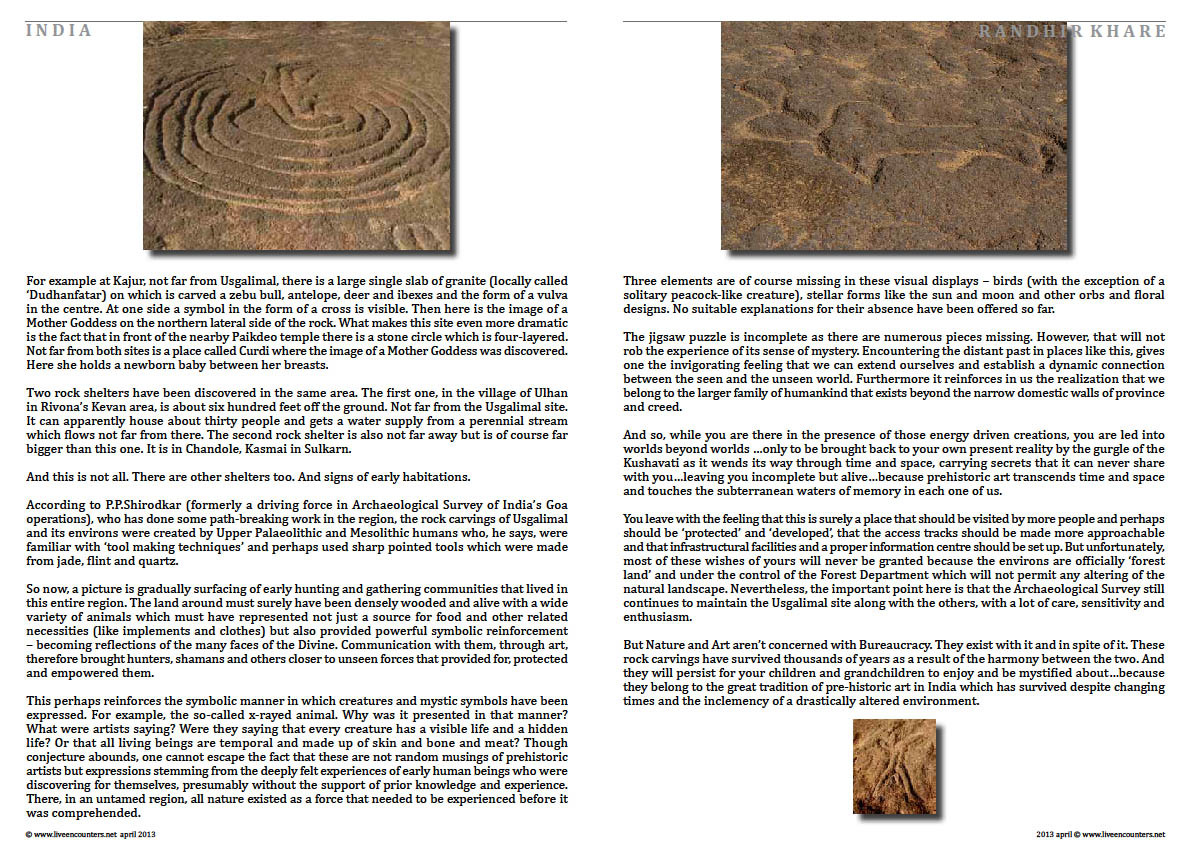
Randhir Khare
Articles in PDF
‘Rock Art’, if one can venture to use such a term, first made its appearance about fifty thousand years ago (according to existing theories). There are in India as many as twenty-two clusters of painted rock shelters. Among them are those in Sheopurkalan, Pachmarhi, Badami, Kota, Raichur, Tekkalkota and Kerala. Generally speaking, the rocks are granite in the south and sandstone in central India, though there may be a few exceptions. The unusual creations in Usgalimal differ from these as they are on hard laterite rock with intense iron content. Apart from this – they are carved and not painted.
————————————————
In ponds, pools, rivers, streams and along the incredible coastline of the Indian peninsular, fishing communities continue their age-old struggle with water – to make it bear fruit. Though each community may have its own social and cultural ethos, a common thread weaves them together into a magnificent tapestry of tradition.
Fishing is perhaps one of the most ancient of human activities on the Indian subcontinent. In streams, pools, rivers, lakes, on shorelines and in the deep sea, people from early hunting and gathering communities caught fish and other water creatures in a variety of different ways. For some, it was only to supplement their diet whilst for others it was an all-encompassing occupation which moulded the very patterns of their lives, beliefs, cultures and community ways.
———————————————-
Folk musicians from Kutch (in Gujarat) have the odds stacked against them. Not only do most of them belong to marginal communities but they also play instruments that aren’t respected any more.
One of the few surviving music masters is Musa Gulam Jath, a Maldhari or cattle herder who lives on the lip of the Great Rann of Kutch. He plays the Jodia Pawa, a double flute. I remember the first time I heard him play at someone’s residence in Bhuj, the district headquarters of Kutch (in Gujarat).
I was given the rare opportunity to experience the triumph of the creative spirit over the vicissitudes of injustice and misfortune. A musician, powered by his talent and tradition, rising out of the difficulties in his personal life to play music that was inspirational. It was both stimulating and humbling.
———————————————
In tribal India, stories have always occupied a special space in the life of the individual, the family and the community because they hold within them the collective wisdom and lore of past generations, kept alive by the word and passed on through the oral tradition.
Because of this, they carry the richness of individual and collective awareness, understanding and perception of the world around and the reverence for all living beings. Probably as important as this, is that they seek to explain the environment around, natural and supernatural phenomena and the whole gamut of human existence including the origins of communities, customs and attitudes. In this way, a single story is multi-layered and swollen with cultural symbols.
Read More…The Living Word – Tales from Tribal India
———————————————
Read more…Beyond Fences - The Nari Kuravar Gypsies in a Time of Change
———————————————
Over the last twenty years Randhir Khare has experienced the mysterious power of the jungles of South Gujarat. There beside the numerous rivers, in the grasslands and forests, in the presence of people from traditional communities and in the sacred spaces, He discovered what it means to belong. These forests were once protected by great Bhil archers who shielded them against invading plunderers. With the coming of British colonial occupation, the Bhils were reduced to poverty and other traditional communities to rootlessness. Today, even the sacred spaces of their mother goddesses are being reduced to rubble as mainstream religions colonise their shrines. But despite the forces of change, the mysterious power of the jungles persists. Here is a n EXCLUSIVE selection from the poet’s unpublished Memory Land, which celebrates this relationship.
Read more…Memory Land - A collection of unpublished poems exclusively in Live Encounters
———————————————
Read more…On the edge of survival
———————————————
Read more…DHANGARS, Their map of life. Tribal India
———————————————-
Read more…THE DANGS - Sacred Green
———————————————-
Read more…Tribal India – Dying Traditions
———————————————-
The traditional communities living in the Nilgiri Mountains of Tamil Nadu in South India hold the natural environment in which they live in great reverence. The Kotas, Kurumbas, Irulas, Moolukurumbas, Paniyas and other indigenous communities, in their own way, relate intimately to the land on which they live. If you have had the opportunity of travelling in that region, you will probably appreciate the reason why such relationships could have evolved. Nature in those mountains displays a stunning variety and resplendence. There is, even today after all the pillaging of its naturalness, an all-encompassing robustness and mystical power that stimulates the senses when you wander the more undisturbed reaches of the region. You will not be overcome by feelings of aloneness or isolation but instead by the presence of natural forces that defy the senses. In lonely glades, under ancient trees, on desolate mountain slopes, besides gurgling streams flowing between flowering rhododendrons and wherever the hidden forces seem most pronounced, you will come across sacred stones of all shapes and sizes, singularly and in groups, known as cairn, barrow, kist-vaen and cromlech and locally called Phin, Hok-kallu (navel stone), Pongui (gold pit), Sela Kallu and Gattige Kallu (throne or seat stones) Bira Kallu (or hero stones), Pandavaru Mane, Savumane, Azaram and Moriaru Mane. These stones have been placed by people from the early pre-historic times down to possible a few hundred years ago. In places it’s also evident that people from indigenous communities today still add such stones to the landscape. The past and present fusing into a composite sacred whole which pervades the very air you breathe.
Read more…Tribal India – Walking with spirits
————————————————
Randhir Khare is an award winning author of twenty one volumes of non-fiction, fiction, translation and poetry. He is the Executive Editor of Heritage India, the International Culture Journal and Visiting Professor of Literature at Poona College. Recently he was given The Residency Award by The Sahitya Akademi (India’s National Academy of Letters) for his contribution to Indian Literature and has been given the Human Rights Award for his efforts to preserve and celebrate marginal and minority cultures. Recently he was honoured by Rotary Club with their Dronacharya Award for his contribution to education.
VIDEOS


Dear Mr. Khare,
I am writing to you on behalf of the Mohile Parikh Center, Mumbai, a not-for-profit organization devoted to the arts. Apart from programs in Visual Arts and Contemporary Culture, we work with children and our focus is education through arts.
I would like to get in touch with you regarding our children’s activities. I came across your work at Junoon:arts at play program. I would be great if you could share your contact details with me so that we could take this dialogue further.
Thanks and regards,
Noopur Desai
Program Executive
Mohile Parikh Center
Mumbai
noopur@mohileparikhcenter.org
Thank you Noopur Desai,
We shall forward your email to Mr.Randhir Khare.
regards
Editor