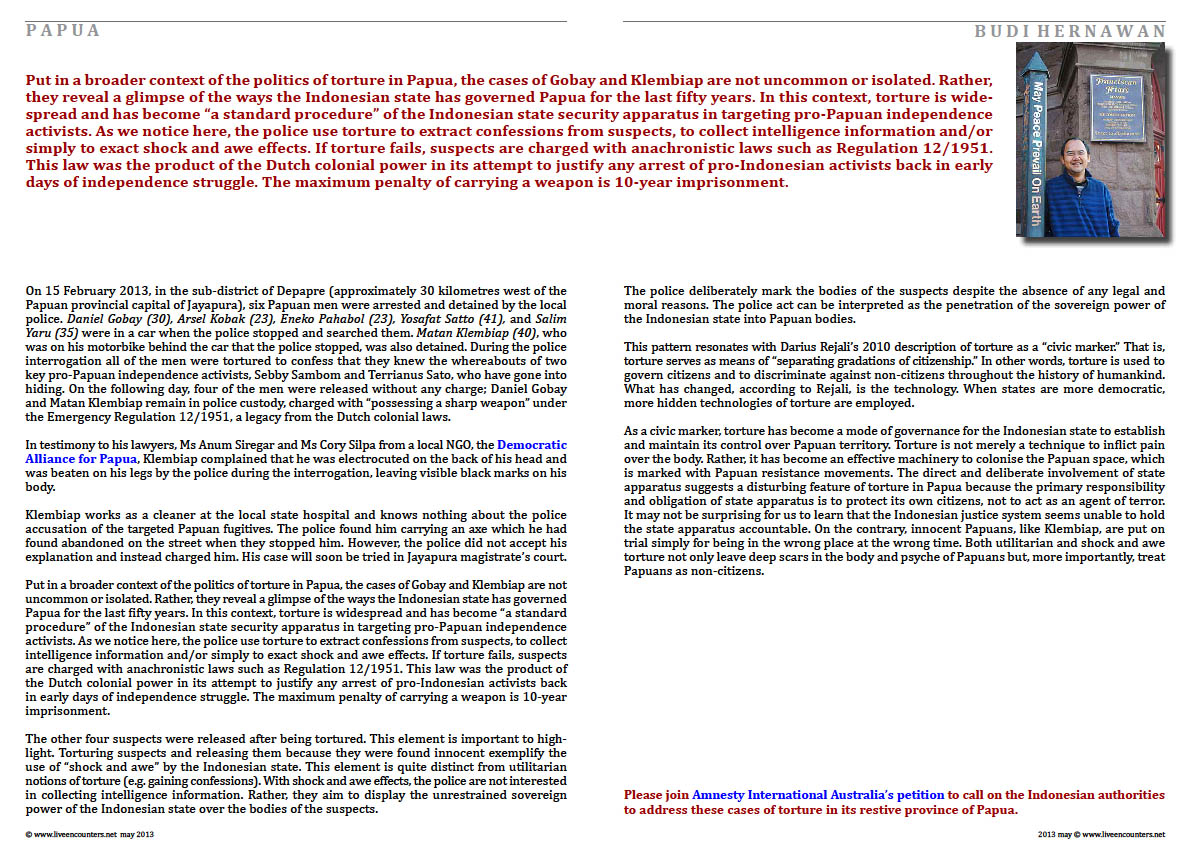
Budi Hernawan

 Article in PDF

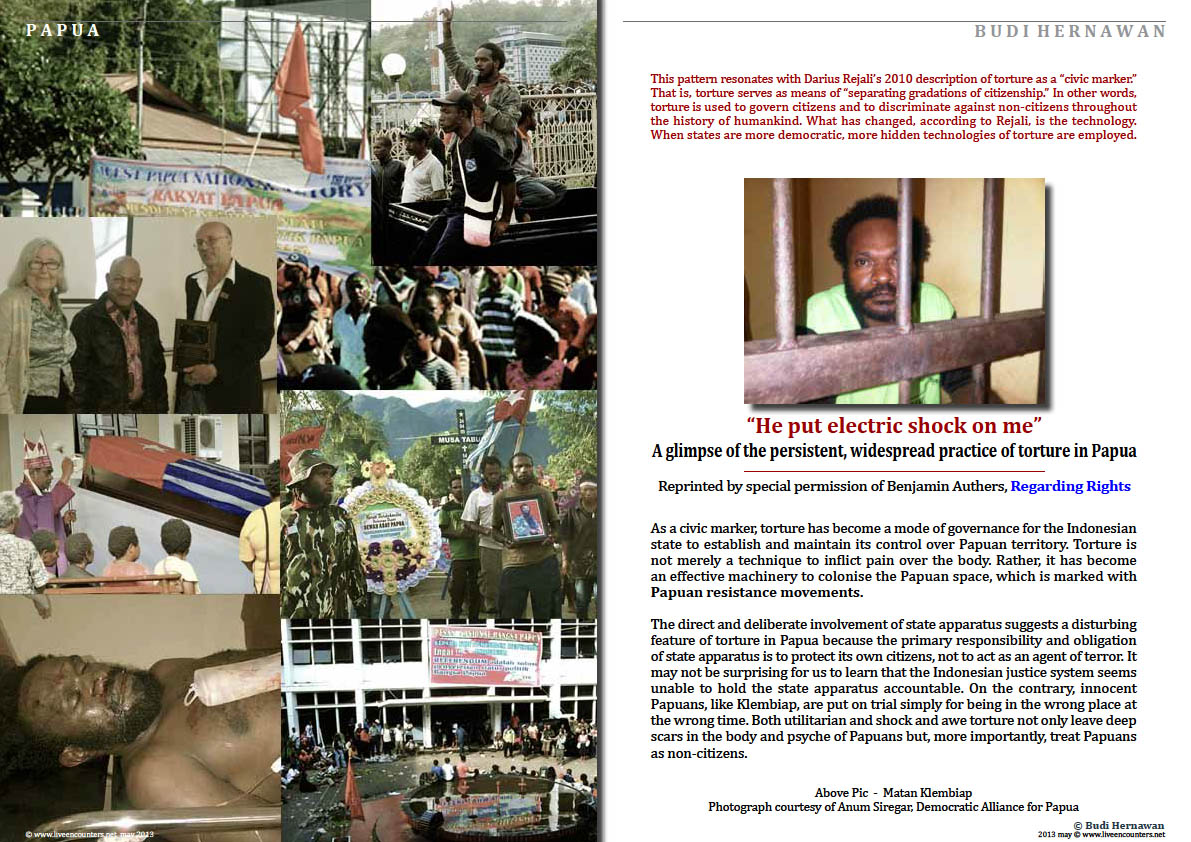
As a civic marker, torture has become a mode of governance for the Indonesian state to establish and maintain its control over Papuan territory. Torture is not merely a technique to inflict pain over the body. Rather, it has become an effective machinery to colonise the Papuan space, which is marked with Papuan resistance movements.

The direct and deliberate involvement of state apparatus suggests a disturbing feature of torture in Papua because the primary responsibility and obligation of state apparatus is to protect its own citizens, not to act as an agent of terror. It may not be surprising for us to learn that the Indonesian justice system seems unable to hold the state apparatus accountable. On the contrary, innocent Papuans, like Klembiap, are put on trial simply for being in the wrong place at the wrong time. Both utilitarian and shock and awe torture not only leave deep scars in the body and psyche of Papuans but, more importantly, treat Papuans as non-citizens.

Read More… “He put electric shock on me” – A glimpse of the persistent, widespread practice of torture in Papua

Reprinted by special permission of Benjamin Authers, Regarding Rights
—————————————–

Dear Editor,

I write to you to raise the issue of a decline in dialogue between the Indonesian government and Papuan people. As you may know, last February the President of Indonesia, Susilo Bambang Yudhoyono, explicitly expressed his willingness to hold dialogue with Papuans to solve the half-century unresolved conflicts in the easternmost provinces of Indonesian Papua. He delivered this statement during an official meeting with the representatives of the Papuan Church leaders who conveyed the request of dialogue from Papuans. During the meeting the President also ordered Vice President Boediono to implement this commitment to dialogue. Further, the President also appointed a special envoy for dialogue, Dr. Farid Hussain, who had been instrumental in Aceh peace process.

Read More…Letter to the Editor

—————————————–

We gather together here to reflect on the essence and challenges of representing the Papuan conflicts in a foreign context, like Australia. We ask questions of how the protracted conflicts of Papua can be made intelligible for the outside world; how to deal with the challenge of presenting the Papuan conflict vis-à-vis the growing concerns of the Australian public towards the boat people who continue to flow in to this country. In this context, we will learn the enormous contribution of Anne Noonan and Joe Collins in making sense the Papuan conflict to the Australian audience.

They are just Papuans  by Budi Hernawan OFM Franciscan friar. Reprinted by Special Permission of Jemma Purdey, Inside Indonesia.

The Wamena example is much more complex than what we see on the surface for two reasons. First, the violence fits into a long pattern that arises out of, and reinforces, the difficult relationship between locals and the army garrison permanently stationed in this area. This relationship has long been marked by cautiousness, suspicion and sometimes hostility. For many people in Wamena, the recent violence is reminiscent of the 2003 Wamena case, for which prosecution is still pending with the Attorney General. In 2003, there was an intensive military operation in the Wamena area following the burglary of the military arsenal there. According to a National Human Rights Commission investigation, during the search for the stolen weapons, soldiers indiscriminately arrested and tortured at least 30 innocent civilians, killed nine others and forcefully displaced the population of 13 villages.

Read More…LINK

—————————————

Budi Hernawan OFM (budi.hernawan@anu.edu.au) is a Franciscan friar, a former director of the Office for Justice and Peace of the Catholic Church in Jayapura and a PhD scholar at the Regulatory Institutions Network, Australian National University.  http://regnet.anu.edu.au/people/mr-yohanes-budi-hernawan


4 Responses

  1. [...] received this message in the mail from Brother Budi Hernawan OFM,  Postdoctoral Fellow, Regulatory Institutions Network, ANU College of Asia and the Pacific, [...]

  2. [...] received this message in the mail from Brother Budi Hernawan OFM, Postdoctoral Fellow, Regulatory Institutions Network, ANU College of Asia and the Pacific, [...]

  3. [...] Budi Hernawan, Postdoctoral Fellow, Regulatory Institutions Network (RegNet), ANU College of Asia and the [...]

  4. [...] Australian Minister for Foreign Affairs. If you could help publish it, that would be great. Cheers, Budi Hernawan, Postdoctoral Fellow, Regulatory Institutions Network (RegNet), ANU College of Asia and the [...]

Leave a Reply

Your email address will not be published. Required fields are marked *

*

You may use these HTML tags and attributes: <a href="" title=""> <abbr title=""> <acronym title=""> <b> <blockquote cite=""> <cite> <code> <del datetime=""> <em> <i> <q cite=""> <strike> <strong>

© Live Encounters
CyberChimps